Quadratic Equations, Class - X
1. What is a first degree equation in one variable called?
Ans: Linear equation of one variable.
2. What is the highest power of the variable in a first degree equation?
Ans: 1.
3. Write the general form of a linear equation in x.
Ans: ax + b = 0, a ≠ 0.
4. What is a second degree equation in one variable called?
Ans: Quadratic equation of one variable.
5. What is the highest power of the variable in a second degree equation?
Ans: 2.
6. Write the general form of a quadratic equation in x.
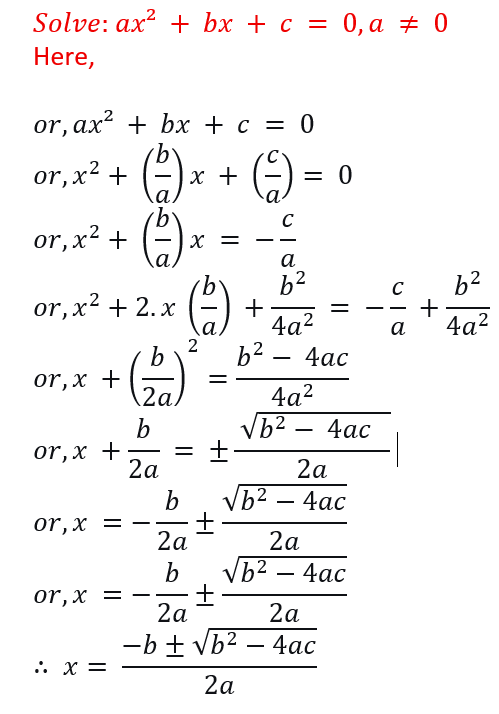
Ans: ax² + bx + c = 0, a ≠ 0.
7. What is the general form of quadratic equation called?
Ans: Adfected quadratic equation.
8. What is a quadratic equation of the form ax² + c = 0 (a ≠ 0) called?
Ans: Pure quadratic equation.
9. Give one example of a pure quadratic equation.
Ans: x² - 64 = 0.
10. Name three methods to solve a quadratic equation.
Ans: Factorization method, completing square method, formula method.
MCQs: Linear and Quadratic Equations
1. A first degree equation in one variable is called a ______.
A) Quadratic equation B) Linear equation
C) Pure equation D) Cubic equation
Answer: B
2. What is the highest power of the variable in a first degree equation?
A) 0 B) 1 C) 2 D) 3
Answer: B
3. The general form of a linear equation in x is ______ (where a ≠ 0).
A) ax² + bx + c = 0 B) ax + b = 0
C) a + b = 0 D) x² + c = 0
Answer: B
4. A second degree equation in one variable is called a ______.
A) Linear equation B) Cubic equation
C) Quadratic equation D) Pure equation
Answer: C
5. What is the highest power of the variable in a second degree equation?
A) 1 B) 2 C) 3 D) 0
Answer: B
6. The general form of a quadratic equation in x is ______ (where a ≠ 0).
A) ax + b = 0 B) ax² + c = 0
C) ax² + bx + c = 0 D) a + b + c = 0
Answer: C
7. The general form of quadratic equation (ax² + bx + c = 0) is also called ______.
A) Pure quadratic equation B) Adfected quadratic equation
C) Linear equation D) Cubic equation
Answer: B
8. A quadratic equation of the form ax² + c = 0 (a ≠ 0) is called a ______.
A) Adfected quadratic equation B) Linear equation
C) Pure quadratic equation D) Cubic equation
Answer: C
9. Which of the following is an example of a pure quadratic equation?
A) x + 3 = 0 B) x² - 64 = 0
C) 2x² + 7x + 3 = 0 D) x + y = 5
Answer: B
10. Which of the following is NOT a method to solve a quadratic equation?
A) Factorization method B) Completing square method
C) Formula method D) Substitution method
Answer: D